







“My,” my father says, “Earth is really full of things!”
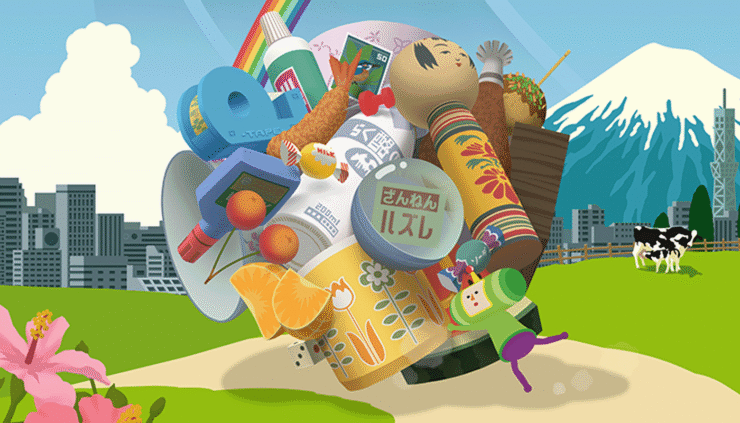
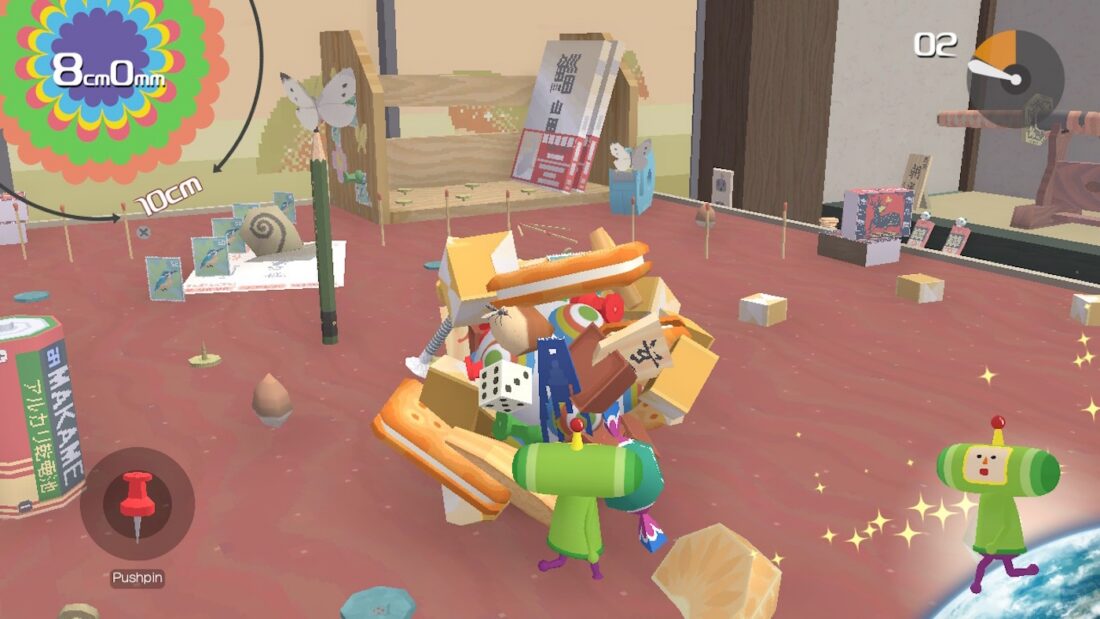
It does not feel like a criticism, even if the things he is referring to are mostly useless. In this colorful realm, it’s my job to tidy up a world that’s reminiscent of my real-world apartment any time one of my disorders compels me to upend every last drawer at once. The things in question are a broad range of objects that amalgamate in any living space: stationery, thumbtacks, toilet paper, batteries, orange peels, tubes of lip balm, potato chip cannisters, and spiders. While a few of these objects—such as Shogi tiles and Hina dolls—would be less commonplace in non-Japanese households, a cucumber is a cucumber regardless of where you’re from, and a mess is a mess.
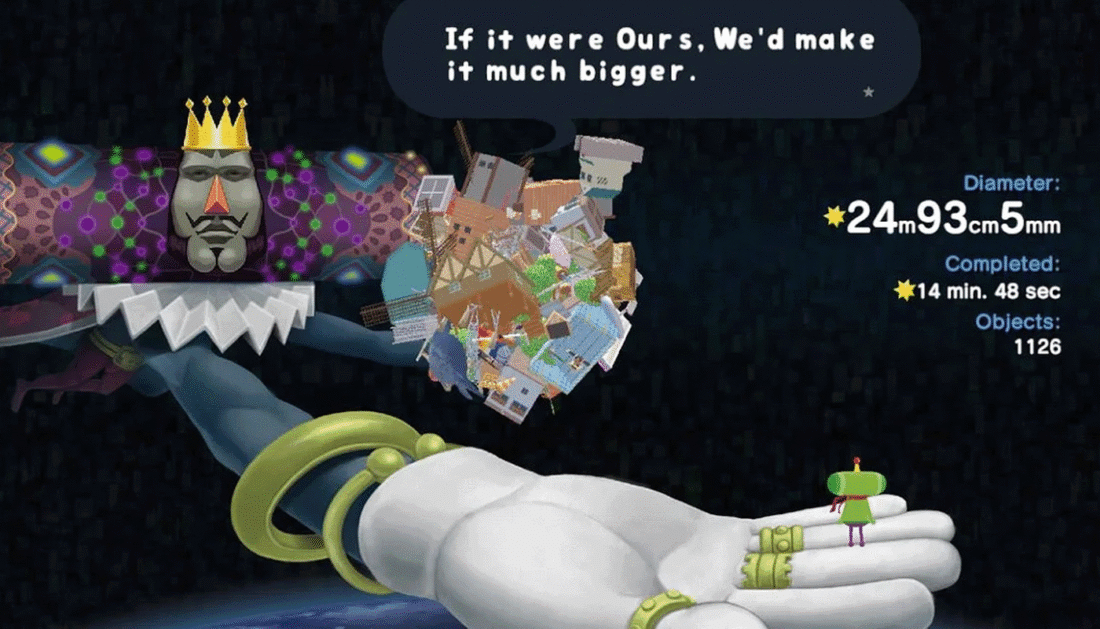
Someone has to clean it up. Your father, who made the mess to begin with, can’t be expected to do it. He is the King of All Cosmos, and has other whimsical, catastrophic plans to look forward to. He has already broken the universe beyond repair, thanks to a naughty bout of drinking that resulted in him somehow erasing every star from the sky. It turns out this has made him very unpopular with the denizens of the universe, and he has to find new stars somewhere, so why not just make them from all those useless things piling up on Earth?
You might resent him for it, and certainly, when Dad asks you to tidy dozens of live crabs from a backyard only to then imply you’ve done a poor job of it, he is a hard person to appreciate. He may be the quintessential Bad Dad™. Like many parents who are quick to delegate the terrible fallout of their selfishness to their offspring, the burden of fixing the universe falls to you. “You owe Us for your existence,” he informs you. “We collect on the debt. Yes?”
How could anyone argue with that inane logic? Besides, in the charming, batshit world of Katamari Damacy, he’s the only dad you’ve got. And if it takes rolling trash, then furniture, then animals, then people, then vehicles, then cities into stars to earn his approval? Well.
For all that this premise sounds bleak, anyone unwittingly exposed to the Katamari aesthetic would never suspect it. In Katamari, the world is made of bright colors, cubed edges (years before minecraft, mind you), and whimsy, set to a fantastic Shibuya-kei soundtrack, which is some unlikely mishmash of genres ranging from jazz to rap to pop. There is much to love about a cult-classic game franchise like Katamari. Whatever more I may say will be more junk rolled into the ever-growing sphere of its long-standing reputation as a triumphant pioneer in the indie-game canon.
But go on, kids! Make stars from the trash your parents gave you…
Dust to Stardust?
I am very late to the game when it comes to admiring Katamari Damacy. The first game was released in 2004, and my family had only just purchased its first shared gaming console, a PlayStation 2. I remember the early ads for Katamari because they exist in the same surreal pantheon of bizarro advertising as that one wild Quiznos sub commercial and the infamous Skittles Midas Touch ad. In the commercial, a secretary walks into a beige lobby and tells a salaryman to follow her. He closes his briefcase and leans forward as if to stand—only to remain seated, pulling the entire sofa with him. The sofa folds into the woman, who becomes stuck to it as well, and then folds out the door and absorbs the cleaning lady. In essence, anything a katamari rolls into becomes part of the growing mass, kicking and mewling and flapping. The commercial is memorable because it breaks one barrier the game never does: the live-action commercial depicts this disturbing fate using human beings rather than pixelated cartoons. It’s a delicate line between dreams and nightmares.
The truth is that Katamari presents the goofiest of body horrors, but body horror all the same. We are all familiar with religions or creeds that tell us we return to the universe after death; or if we aren’t religious, we at the very least know the Law of Conservation of Mass: matter can neither be created nor destroyed. As creatures composed of organic stuff, we have a lot more in common with the junk in our houses—nail polish bottles and toilet brushes and our silly little tchotchkes—that we might like to admit. Eventually, we all decay and merge with the world again. Take your pick of oracles—Carl Sagan or Moby or any random fantasy novel—and consider the message they convey: we are all made of stardust.
And maybe it isn’t trying to be that deep, but Katamari goes one step further. What if the stars are instead made of us? I am oddly charmed by this more ambitious doom. Rarely is the transition from cognizant individual to squirming mindless mass so abrupt, or, well… amusing? I am delighted whenever I absorb a screaming schoolboy or a pompadoured Yankee. The twinge of guilt I feel when I roll over another tomcat and hear his questioning “Meow?” as he becomes one with my rolling hell-cluster is immediately quelled by the knowledge that he and all his new companions will make for a beautiful star.
It might come as no surprise that this whole beautiful disaster of a game was the brainchild of an art student. The series creator, Keita Takahashi, was a talented graduate from Musashino Art University, the same university that produced auteur Satoshi Kon, Hello Kitty creator Yuko Shimizu, and horror author Ryu Murakami. Takahashi was known for his eccentric, playful sculptures, among which was a goat-shaped planter that drained water through its udders. He grew bored with sculpture and began working in the art department of Namco in the late ’90s, where he found himself brainstorming new games. According to Takahashi, the seed of the idea for Katamari began with fond recollections of an old arcade game—I mean, 1880s old—tamakorogashi. You’ve played some iteration of it, probably; remember those plastic keychains with metal balls inside, and the objective was to spin or tilt the damn things until each ball rolled into a corresponding hole? Tamakorogashi is also credited as one of the major inspirations for modern pinball.
Perhaps it is a testament to the oddity of Takahashi’s brain that he realized his ambition to create a game that was “not formulaic” by designing a game around so mundane a concept as cleaning up a mess. Of course, we could all clean up our houses instead of playing, and find our lives better served: “You don’t need cleaning in a video game, son: we have cleaning at home!”
But that’s not the point. The point is that even the dullest, simplest chores in life can be reimagined and transformed into something playful. With a stable of young game designers at his side, the Katamari Damacy project slowly gained traction. It was not an easy sell, and Namco remained unconvinced until Takahashi secured a student aid grant to help develop the project further.
It has since spawned a critically acclaimed franchise containing more than twenty games, and has been frequently cited as a major inspiration for independent game designers. This impact is probably greater than I have any real sense of—I have played a lot fewer indie games than most avid gamers, which is why it took me twenty years to fall for the Prince and his Bad Dad. Even so, I have felt the impact of Katamari in unlikely places. In the horror game Inside, for example, there comes a point when the player character, a frightened little boy, begins merging with other human beings to form a screeching mass of rolling flesh.
Na-naaaa, na na-na na-na na na, na Katamari Damacccccy!
Ghost in the Slipper
The word “katamari” means “cluster,” and “damacy” means “soul.” That’s a great title, because this stuff has a real soul, buried under layers of sheep and shopping carts and a kraken or two. The objects we surround ourselves with do help us ground ourselves in the world and define who we are, after all—you can pry my collection of yokai-cat figurines or my Blythe dolls from my cold dead hands.
Here in Japan, there exists extensive folklore about a specific type of yokai (spirit) known as tsukumogami. The word translates to “object ghosts.” According to legend, objects that reach 100 years in age are granted sentience. While many yokai have sinister intentions, most tsukumogami are innocuous, playful creatures: the awakened koto that plays forgotten memories at night, a talkative tea kettle used as a peace offering in a historic tale. While tsukumogami stories maintain a unique charm, most cultures share stories about magical objects. In the immortal words of a charming candlestick in one Academy Award-winning animated film, “Don’t believe me? Ask the dishes.”
While tsukumogami stories deliver a variety of moral lessons, many warn owners not to neglect their possessions. Things, however cheap or simple, should be taken care of. Culturally, this notion remains a core principle in Japan. Anyone who goes thrifting in Koenji can tell you that secondhand items are usually in impeccable, often brand-new shape. In general, despite the gachapon refuse and endless layers of plastic wrapping and disposable utensils, Japanese values place a lot of emphasis on the concept of mottainai: waste not, want not. Compounding this, perhaps? It is exceptionally difficult to get rid of trash in Japan, thanks to strict rules about rubbish sorting and specific pickup days. People who are overwhelmed, depressed, or busy are bound to miss these days and find themselves slowly surrounded by piles of plastic bags. You might be familiar with anime or news reports about hikikomori dens, where people withdraw and live in isolation. While many families take part in a traditional deep cleaning before the New Year, those who don’t maintain bonds with family sometimes avoid any such activity. In Japan, it is quite rare to be invited into someone’s apartment, and much more common to meet in a third space. In short, it is all too easy for one’s home to become a guilt-ridden temple of hidden waste.
But there is zero shame in the messes of Katamari. Roads cluttered with cones and thermoses and yards buried beneath toys and cleaning supplies and appliances are vibrant landscapes, as fun to explore as they are satisfying to clear. Nothing is hidden away, and the larger your katamari grows, the more it can absorb, until even pets and people become part of it. If our stuff is junk and so, ultimately, are we, why should we feel bad about it? We are what we are. It doesn’t mean everything is meaningless. Every object is catalogued with measurements and a blurb as it joins your cause, evidence that a life is being lived, shedding candy wrappers like our bodies shed hair and skin. Gross? Who cares.
I do not think that Katamari is trying to make one clear statement about consumption. Instead, I think it takes an insightful look at the chaotic world we’re all inhabiting and finds the beautiful levity in it. It might be impossible for us to really clean up our planet, and maybe it’s ludicrous to try, but by golly, this little guy is trying anyhow, so who cares if his dad is a hater? The true catharsis in Katamari comes not from tidying up a room, but tidying up the mind along with it.
Don’t you ever stop, lonely rolling star! Keep going.
Konmari vs. Katamari?

Professional organizer Marie Kondo suggests that every object thrown away should be thanked for its service before being disposed of. Teddy bears should be blindfolded before meeting the trash bag so we don’t incur guilt looking into their eyes one last time. Unwanted gifts on our shelves should be appreciated not for what they are, but for the sentiment, which frees us from having to keep that damn ugly sweater. Give each object a salute and then chuck it, until you are surrounded only by those things that make you happy. This approach to organizing a life has been effective for me and countless others.
The katamari approach is less mindful but just as satisfying. It does not hurt that it is imaginary. The therapeutic benefits exist all the same. The soundtrack alone is the aural equivalent of touching grass.
The mess in these games is ultimately unconquerable, especially for a subpar player like me. Katamari is known for its unique controls. Using two Joy-Cons is as essential as rowing on both sides of a rowboat if you don’t want to go in circles. In real life, my coordination could never. But with practice, navigating that rolling adhesive ball becomes easier and easier. It’s rare to sense improvement so concretely in gaming. It’s weirdly encouraging, and maybe that’s another lesson: Managing the mess of daily life is a challenge, but it can get easier. The point is to keep rolling, because what the hell else can we do?
I should really clean my apartment. It will only get messy again, sure, but there will be a brief few days when the sunlight hits the apartment walls just right and the cat dander does not overwhelm me—and then I can sit on the sofa and play Katamari in peace.
